
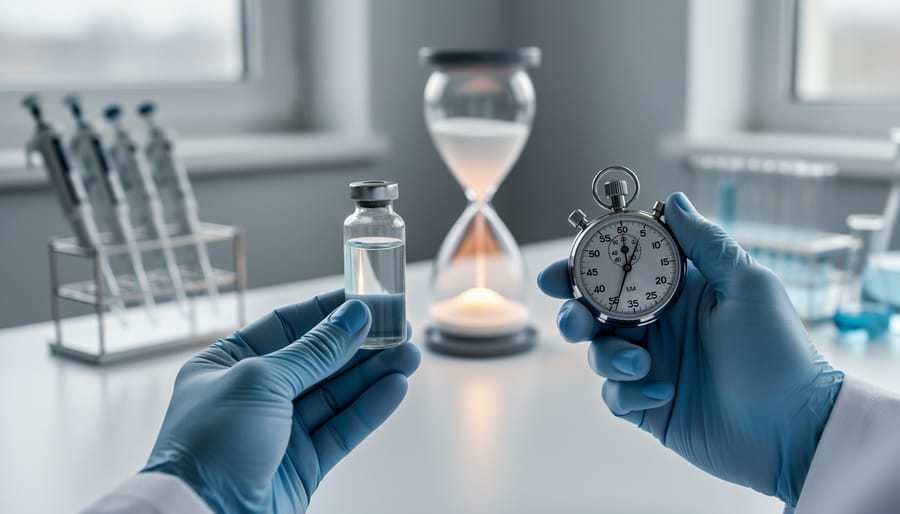
Peptide half-life is the time it takes for the concentration of a peptide in the body to drop by half. In preclinical studies, that single number shapes almost everything else, as researchers exploring Kylo Peptides (Canada) will find: how often a compound is dosed, when blood samples are drawn, how long a study runs, and which animal model makes sense. Many peptides are cleared in minutes because enzymes break them down quickly and the kidneys filter them out, so a poorly timed sampling schedule can miss the signal entirely. Getting half-life right early saves time, animals, and budget.
This article explains what half-life means, how researchers measure it, and why it drives study design. It also covers the approaches used to extend it and where the data falls short. If you’re looking for educational background on research peptides in Canada, that is one place to start. Everything here is for general education only, not a recommendation for any compound or personal use.
What Peptide Half-Life Means in Plain Language

Think about a cup of coffee. You drink it, the caffeine peaks in your system, and then it slowly fades. After a certain stretch of time, about half of that caffeine is gone. A while later, half of what remains disappears, and so on. That steady halving is the idea behind half-life: the time it takes for the amount of a substance in the body to drop by half. The formal term is pharmacokinetic half-life and it applies to everything from caffeine to medicines to peptides.
A peptide is simply a short chain of amino acids, the same building blocks that make up proteins, just in a much smaller package. Because they’re small and delicate, many peptides get broken down quickly by the body, which makes half-life especially interesting to researchers.
“Preclinical models” refers to the laboratory and animal research that happens before any studies in people. It’s the early testing ground where scientists learn how a compound behaves, and half-life is one of the first things they measure. It tells them how long a compound sticks around, which shapes almost every decision that follows.
Here are the key terms in plain language:
- Peptide
- A short chain of amino acids, smaller than a full protein.
- Half-life
- The time it takes for the amount of a substance in the body to fall by half.
- Preclinical model
- A laboratory or animal system used to study a compound before human research begins.
- Pharmacokinetics
- The study of how a substance moves through the body: how it’s absorbed, distributed, broken down, and removed.
- Clearance
- How quickly the body removes a substance from the bloodstream.
- Bioavailability
- The portion of a substance that actually reaches the bloodstream in usable form.
One common mix-up is worth clearing up now. Half-life is not the same as how long an effect lasts. A compound can leave the bloodstream quickly yet still trigger changes that linger, or the reverse. Half-life tells you about presence, not impact.
How Peptide Half-Life Works: What Happens After a Peptide Enters the Body
The Journey: Absorption, Breakdown, and Clearance
Picture a single dose of a peptide entering a research model, and follow it step by step.
First comes absorption. Once the peptide is given, it has to reach the bloodstream. That happens quickly if it’s injected directly into a vein, and more slowly if it’s injected under the skin or into muscle, since it has to travel through tissue first. Some of the dose may be lost along the way.
Next is distribution. The bloodstream carries the peptide around the body, and it may leave the blood to spread into surrounding tissues. Researchers track how much stays in the blood because that’s what they can measure most reliably.
Then the breakdown begins. Enzymes, which act like tiny molecular scissors, snip peptides into smaller fragments. Because peptides are short chains of amino acids, many are cut up fast.
Finally, clearance. Small peptides are often removed by the kidneys, a process known as renal filtration clearance. The remaining fragments are filtered out and excreted.
Together, these steps explain why the amount in the blood falls over time, and why that drop is what half-life measures.
Factors That Make Half-Life Longer or Shorter
Several things push a peptide’s half-life up or down, and they rarely act alone. Here are the main ones researchers weigh:
- Structure and chemical modifications: small tweaks to a peptide’s shape or building blocks can make it harder for enzymes to chew through.
- Enzyme activity: proteases in blood and tissue snip peptides apart, so more activity usually means faster breakdown.
- Kidney clearance: small peptides are filtered out quickly, while larger or protein-bound ones tend to linger.
- Route of administration: how a compound enters the system changes how fast it’s absorbed and what it meets along the way.
- Formulation: the carrier or delivery format can slow release and shield the peptide from degradation.
Since the list above uses formatting tags, here is the same point in plain terms: structure, enzymes, kidneys, route, and formulation all shape the number you end up measuring.
Here’s the catch for study design. These factors differ between species. A mouse, a rat, and a monkey can each clear the same peptide at very different speeds because their enzymes, kidney function, and metabolism aren’t identical. That’s why a half-life from one model shouldn’t be treated as a universal figure.
Why Half-Life Shapes Study Design
Timing Samples and Dosing Schedules
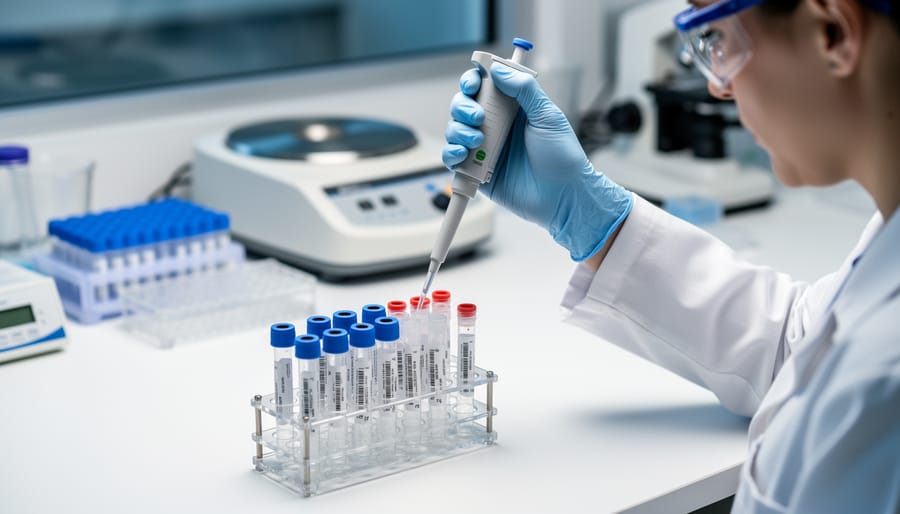
Half-life gives researchers a clock to build around. A common rule of thumb is that a compound is mostly cleared after about four to five half-lives, so the sampling window usually needs to stretch across that span to capture the full rise and fall.
Picture a hypothetical peptide with a half-life of two hours in a given model. A team wants to see how its blood concentration changes over time. Sampling only at 24 hours would be pointless, since almost nothing would be left to measure. Instead, they’d cluster early samples around the expected peak, say at 15 minutes, 30 minutes, and one hour, then space later ones out at two, four, and eight hours to catch the decline.
Dosing intervals follow the same logic. If doses are given every hour for a two-hour half-life, the compound piles up and the readings drift upward, which can muddy the picture. If they’re spaced too far apart, levels may drop to nearly zero between doses. Matching the schedule to the half-life keeps the data clean and easier to interpret.
Choosing the Right Model and Reading the Results

Not every lab animal handles a peptide the same way. Mice tend to clear compounds faster than larger animals, thanks to higher metabolic rates, different enzyme activity, and differences in kidney filtration. A peptide that fades from a mouse’s blood within minutes might linger noticeably longer in a rat or a larger species. That’s why researchers pick a model deliberately, based on how closely its biology matches the question being asked, rather than just using whatever is on hand.
It also explains why a half-life figure from one model can’t simply be copied into another. The number belongs to that species, that dose, that route, and that formulation. Change any of those, and it can shift.
Reading results carefully means keeping those limits in view. A clean half-life curve in animals is useful for planning the next experiment, but it doesn’t directly predict what would happen in people. Humans differ in enzymes, body size, and clearance, so animal data is a starting point for further study, not a final answer.
Types of Approaches Researchers Use to Study and Extend Half-Life
Researchers tackle half-life from two directions: measuring it accurately, and sometimes trying to stretch it. Both stay conceptual here, since the exact lab methods vary a lot from one project to the next.
Measurement usually comes down to a simple idea. You give a peptide to a research model, then track how much remains in the blood at different points in time. Analytical testing, often a technique that identifies and counts specific molecules in a sample, turns each blood draw into a number. Plot those numbers over time and the half-life falls out of the curve.
Here’s how the main approaches break down:
- Serial blood sampling: small samples are collected at planned intervals to show how peptide levels rise and fall.
- Analytical testing: laboratory instruments measure how much peptide is in each sample with high precision.
- Chemical modifications: small changes to the peptide’s structure can make it harder for enzymes to break it down.
- Protective structures: attaching or pairing the peptide with a larger carrier can shield it and slow kidney filtering.
- Delivery formulations: special preparations can release a compound more gradually, changing how long it stays detectable.
Notice that extension strategies change the peptide’s behaviour, so they need fresh measurement every time. A tweak that helps in one model may do little in another.
It also helps to remember that a measured half-life doesn’t tell you how long an effect lasts. That’s a bit like asking, as people do when they wonder does CBD make you tired how long a compound lingers versus how long you actually feel something. They’re related questions, but not the same one.
How Half-Life Data Is Used in Research and Where It Falls Short
Half-life data earns its keep in early-stage research because it gives scientists a common yardstick. When a lab is weighing several candidate compounds, comparing how quickly each one clears from the bloodstream helps narrow the field. A compound that disappears in minutes may need a different delivery approach, while one that lingers longer may be worth a closer look. The same numbers also guide dose selection, since they hint at how often a compound would need to be given to keep levels steady. And when a team decides whether a candidate deserves further studies, half-life is one of several pieces of evidence on the table.
Still, the number has limits. A half-life measured in one species often doesn’t carry over to another, because enzymes and kidney function differ. Early studies also tend to use small groups, so a single figure can hide a lot of natural variation. Most importantly, there’s a real gap between preclinical results and what happens in people. A tidy curve in a lab model is a starting point, not a prediction.
A quick safety note: peptide research belongs in qualified, regulated laboratory settings. If you have questions about any compound, talk with a licensed professional and check Health Canada guidance rather than experimenting on your own.
For Namaste Vaping readers, there’s a useful takeaway here. Just as this topic rewards checking sources and understanding the science, it pays to bring the same evidence-first mindset to any product you use. Looking into vaping health risks is a good example. Buy only from reputable Canadian retailers, and remember that vaping products are an adults-only, age-restricted purchase.
Common Questions About Peptide Half-Life in Preclinical Studies
Researchers and curious readers tend to circle the same handful of questions when they first meet this topic. Here are the clearest answers, kept short on purpose.
Is a longer half-life always better?
No. A longer half-life can mean a compound lingers longer than a study needs, which can blur results or complicate interpretation. The right half-life depends on what the research is trying to learn.
Does half-life equal how long the effect lasts?
Not necessarily. Half-life describes how fast the amount in the bloodstream falls, while an effect can fade sooner or continue well after the peptide is mostly cleared.
Why do results differ between species?
Different species have different enzyme activity, kidney function, and metabolism, so the same peptide can clear at very different speeds. That’s why a number from one model rarely transfers cleanly to another.
Can half-life numbers from animal studies be applied to people?
Not directly. Preclinical numbers are useful for planning and comparing early candidates, but they don’t predict human outcomes on their own.
So where can you find reliable information? Start with peer-reviewed journals, university research pages, and guidance from Health Canada, and be wary of vendor pages or forums that make big claims without citing sources.
That same evidence-first habit is worth carrying into everyday choices. If you’re an adult new to the category, a good starting point is our guide to vaping for beginners and it helps to read up on the basic vaping facts before you buy anything. Vaping products are for adults only, so stick with reputable Canadian retailers.
Peptide half-life might look like one small number in a lab report, but it quietly steers almost every decision in early research. It tells scientists when to take samples, how often to dose, which model fits the question, and how far the results can be trusted. Get it wrong, and even a carefully run study can produce data that’s confusing or unusable.
The bigger lesson applies well beyond the lab: good conclusions come from good information. Check where a claim comes from, understand the limits of animal data, and be wary of anything that sounds too certain. That evidence-first habit serves you just as well when you’re weighing any product you use.
If you enjoyed this plain-language look at the science, keep exploring the educational articles here on Namaste Vaping. We’re always working to make complicated topics clearer for Canadian adults.